
The opening scene of Juan Cuarón’s 2001 Y Tu Mamá Tambien begins with a young couple having sex––the protagonist making his girlfriend swear, to promise to be faithful to him before her trip to Italy. Not an Italian, not a Mexican in Italy, not any other guy, no one but him, she swears. Graphic sex and sacred vows repeat as themes of desire, broken trust, and recurrent transgression in the film. Coupled with a nuanced exploration of Mexican culture and class issues, cult fandom for the film grew steadily as years passed. What makes the film a cult phenomenon all these years later lies in its use of the road movie genre and extradiegetic narration, or the voice offscreen. An unnamed and unseen narrator creates intimacy between the audience and the characters while exploring the Mexican cultural and political landscape. Now, twenty-five years after its release, pilgrimages to the fabled beach are embarked upon, manifestos between friends are made, DVD and digital formats are collected, all as part of the enduring legacy of Y Tu Mamá También (Letterboxd 2026, Llamas-Rodriguez 4). In a Letterboxd interview with Diego Luna and Gael García Bernal, both actors recount how at the film’s initial release, a sense of mystery and discovery prompted fans to find the restaurant and beach where the characters share a threesome. Now, the famed Boca del Cielo can be found via google maps by fans who plan trips that retrace the steps of the characters in the film. The author of the book Y Tu Mamá También, Juan Llamas-Rodriguez, recounts how he “own[s] six copies of Y Tu Mamá También: three dvds (for regions 1, 2, and 4); the Blu-ray special Criterion Collection edition; and two digital copies (720p and 4K). None of these hold the same emotional weight as [his] first bootleg vhs, which [he suspects] has long been discarded” (Llamas-Rodriguez 4). Such fan practices, those of pilgrimage and collection, prove the film’s cult status which are rooted in an individual’s relationship to the film. My own relationship to Y Tu Mamá Tambien falls under adoration and awe. The film had a profound impact on my life. At first viewing, I engaged with the story of two boys exploring their sexual freedom in the long and sunny days of the summer before school. After repeat viewings, I began to see different aspects of Y Tu Mamá También come to life. I formed my own manifesto. I zeroed in on details; I evaluated my positionality in a story about class and culture. In a transnational reading, I questioned what it means to grow up in the U.S. against the vibrant scenes of beauty and injustice found in Mexico. Because the film engages with viewers on personal, social, and political levels, it inspires adoration from fans who form a deep connection with not only the transgressive content of the film, but its mode of storytelling. The love viewers share for Y Tu Mamá También transcends the simple story of friendship and sex to include the depth of Mexican life and culture, a window into what it means to live in beauty and injustice, joy and pain, told through the biting honesty of the film’s narrator on a meandering journey towards the sea.
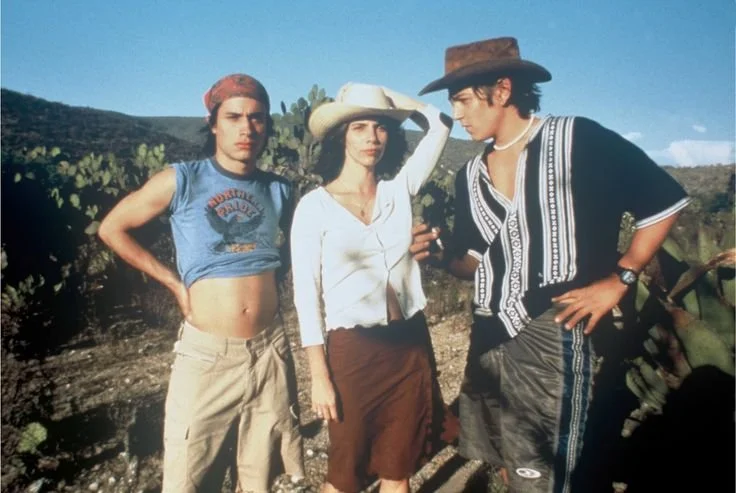
Julio, Luisa, and Tenoch pictured from Y Tu Mamá También
The audience joins in the character’s trip through Mexico, from adolescence into adulthood, caught between sexual freedom and desire, with the contextual grounding and the safe distance of omniscient narration. The audience is allowed to safely transgress, to anticipate the homoerotic sexual competition and exploits between two friends, even to comprehend and understand the injustices of class division in Mexico, but for the status quo to reign, for a true and liberated sexuality to succumb to shame, and for the ambivalence of life to suffering to continue. Cult films thrive on the exaltation of the taboo and the restoration of the norm, which is clearly and excruciatingly realized in the film. “All cult movies… in some way involve a form of “transgression” and… this quality is central to their appeal. This transgression can manifest in terms of subject matter,” such as unrestrained sexual desire, infidelity, and homoerotic elements (Grant 123). Y Tu Mamá También subverts and upholds social and moral norms when the narrator delineates the borders crossed between trust and betrayal for the film’s protagonists. Luisa, the older woman and the temptress, wields transgressive power in the shambles of her marriage when she decides to go on a road trip with Julio and Tenoch to Boca del Cielo, a blur between sky and sea. Julio and Tenoch, amigos del alma and charolastras, masturbate to the thought of her on opposite and parallel diving boards before their voyage. The scene sequence, of them fantasizing to different women until they climax to Luisa, is an emblem of their homoerotic intimacy. A shot of their semen hitting the pool’s surface from beneath the water punctuates their desire and foreshadows the threesome at the film’s conclusion. Luisa’s role is more than just object for the boys to lust after. “They are in awe of Luisa, and Cuarón knows that she’s the powerful one in the trio” (Taylor 2014). The extradiegetic narration gives insights into Luisa’s motivations and fears, adding dimension to her character. For example, the narrator reveals her answers to a questionnaire taken from a magazine in a hospital waiting room: she is ‘a woman who is afraid of her sexual power and independence.’ The journey from Mexico City to Oaxaca serves as the pretext for her to liberate herself from an unhappy marriage to Jano, whose constant infidelity drives her to seek adventure. She cries in hotel room after hotel room when she’s left alone with her thoughts, traveling with Tenoch and Julio. The camera is a voyeur to her pain, just how Tenoch tried to spy on her for a moment through a streaky window. The viewer feels connected to her through several glimpses into the personal details of her life, a life she leaves behind as the film progresses. Eventually Luisa lets her pain turn into desire, into independence. Tenoch and Luisa have clumsy and brief sex when he walks in on her while she is in tears. The camera work is as shaky and awkward as the encounter. The narrator later describes the pain in Julio’s stomach when he discovers Tenoch and Luisa together, emphasizing the jealousy he feels. Without the narration, the audience would not know the depth of his disappointment. In the dirty hotel pool where leaves brush the water’s surface the boys swim naked, and naked, Julio reveals that he had sex with Ana, Tenoch’s girlfriend. In violation of the Charolastra Manifesto, Tenoch berates Julio for his sin and transgression of having had sex with a charolastra’s girlfriend. When Luisa perceives a shift in Tenoch and Julio’s dynamic, it is the narrator who reveals Luisa’s thoughts, her inner world, once again. He says that Luisa thought she disrupted a careful balance that only she could restore. The narration provides a moment of dramatic irony where the audience participates in her transgressive actions with full knowledge of the pain they leave. The next day, she has sex with Julio in his sister’s car. Cult audiences anticipate the betrayal and understand its influence because of the context Luisa lacks and realizes only too late. The charolastras end their friendship when Tenoch tells Julio that: him too, yo también, he had sex with Julio’s girlfriend too. Betrayal and transgression continue to dominate as themes of the film, especially as they relate to friendship and the broken manifesto, made more clear by the extradiegetic narration. In the homophobic climate of Mexico in the 2000s, the most transgressive moment of the film, however, does not come from the boys fighting, but rather, when they share a deep and passionate kiss in a threesome with Luisa. After having sex, they can barely look at each other. The film upholds the status quo at its conclusion––everything has changed between Julio and Tenoch, but not the machista culture they belong to. “[Cult films] recuperate that which initially has posed a threat to the dominant ideology,” and so does Y Tu Mamá También (Grant 135). The plot, the text, the conventions of the road movie, and the narration, all contribute to the cult phenomena of the film. The extradiegetic narration gives the audience a glimpse into the private details of the characters’ interiority. The road movie follows a clear path from adolescence to maturity through time and through the territory of Mexico. Both narration and road movie contribute to cult readings of Y Tu Mamá También, especially as they relate to transgressive themes.
The character plot of the film is only one of the aspects that contribute to the cult status of Y Tu Mamá También. In fact, I argue that the story is secondary to the extradiegetic narration of the culture and politics of Mexico. In Reality, Myth, Allegory and the Nation in Y Tu Mamá También (Realidad, mito y alegoría de la nación en Y tu mamá también), Christian Wehr notes that Julio and Tenoch’s dynamic acts as a metaphor for the political and class struggles in Mexico.
“From this perspective, their intersubjective relationship can be interpreted as a personification of the political situation of the country in the 80s and 90s, particularly in conflicts between the PRI (Institutional Revolutionary Party) and the National Democratic Party, the coalition of political forces created in 1989” (235). [1]

Image reads “Mexico without PRI (Institutional Revolutionary Party)
Bodily metaphor is further emphasized when the narrator comments how Julio lights a match after going to the bathroom in Tenoch’s house to cover up the smell and that Tenoch lifts the toilet seat in Julio’s house with his foot to avoid contact. The narration gives the audience context for the political and class separation between the two. Julio was raised by a single mother while Tenoch’s father belongs to the Presidential cabinet in Mexico, known for the corruption of the elite against the working classes. “For the duration of the Institutional Revolutionary Party, the privileges obtained from corruption became a way of life that the lower classes, like Julio in the movie, only achieved through befriending [others] and climbing up the social ladder” (Colpaert, Poppe 61). [2] As the narrator divulges the unsaid tension between Julio and Tenoch, the audience becomes attuned to a class-conscious viewing of the film, which resonates and connects to cult fans on a greater level. For Mexican fans in particular, the cultural specificity and localism of the film speak directly to the audience with the use of slang and repetition of visual motifs, such as altars and crosses on the roadside. Even for the non-Mexican viewer, a cult like fascination with Mexican culture builds on the journey to Boca del Cielo. Luisa, the Spanish foreigner, gives non-native viewers the opportunity to learn new information about Mexican mannerisms and customs they might not be familiar with. Being invited into these conversations through her questions and misunderstandings gives the viewer the chance to participate in the film with more attention and care. Further, the road movie genre contributes to the breadth of discussion as vignettes of Mexican life are shown to the audience through the journey. “In one scene set in a small restaurant, the camera voyeuristically lingers on the main characters, and then later decides on its own to pan over and track behind an older woman who works at the restaurant, toward the kitchen where a group of older Mexican women is seen preparing the food. These environments are so rich with character” (Dorado 2021). Out of the window in the car that Julio borrows from his sister, a roadside inspection takes place with armed military police who take passengers aside. Tenoch tells Julio not to look, but the camera focuses on the police presence after the car has passed. Conversely, poverty-stricken towns are glossed over as pedestrians gather on desolate streets. Luisa finds a mouse plushie with her name on it, cherishing it as a gift from Doña Martina’s altar. She later gives the toy to Chuy the fisherman’s daughter. Such sweet and tender moments contrast the scenes of Mexico where inequality and injustice run rampant. The road movie gives the viewer a sense of Mexico with small moments of beauty collected through the pueblos along the way to Boca del Cielo. These explorations were so resonant that they inspired pastiche from Western audiences. “The music video for US teen pop sensation Jesse McCartney’s Billboard Hot 100 hit “Beautiful Soul” (2004) restages multiple key scenes from the film, including the car prank at the gas station, the old woman gifting a doll to the love interest, the leads swimming in a dirty leaves ridden pool, and the final celebration scenes on the beach” (Llamas Rodriguez 13). The text and the narration obviously strike a chord with viewers because of the vulnerability and intimacy they elicit. Intimacy and depth, shown through narration and the road movie genre, are the reason Y Tu Mamá Tambien enjoys a cult audience to this day.
Work on audience response to Y Tu Mamá También could reveal more of the film’s cult status, especially in a longitudinal study that tracks both initial and continued reception of the film’s transgressive themes and depictions of masculinity. However, textual elements, namely those of the narration and the road movie, more than prove how and why the film is cult. Though cult audiences engage with the film on an individual and private rather than public and communal basis, with bookings to a trip or the memorization of the charolastra manifesto, audiences still love Y Tu Mamá También beyond all reason. Moreover, because of the social commentary, the political metaphors, and the transgressive themes of the film, Y Tu Mamá También experiences cult fandom and fascination on a profound level. The narration, the road movie are filmic elements that give viewers the urge to live life, not only more fully, but with more attunement to subtleties which go unsaid. Listening for the voice that reveals the truth beyond the surface allows viewers to listen more carefully to silence and tension in their own daily life. Both the extradiegetic narrator and the road movie give cult audiences an unforgettable insight into the character of Mexico, the character’s inner worlds, and hopefully, into their own life.
[1] Desde esta perspectiva, su relación intersubjetiva puede interpretarse como la personificación de la situación política del país entre los años ochenta y noventa, particularmente en las disputas entre el PRI y el Frente Democrático Nacional, la coalición de fuerzas políticas mexicanas creada en 1989 (Wehr 235).
[2] Por la larga duración del gobierno del PRI, los privilegios y la corrupción llegaron a ser un modo de vivir en el que las personas de origen más bien bajo, como Julio en la película, solo disponían del amiguismo para ascender socialmente (Colpaert, Poppe 61).
Works Cited
Colpaert, Nikolaas, and Poppe, Emmy. Los Hijos Chingados: El Estereotipo Del ‘Charolastra’ y de La ‘Extranjera Fácil’ En Y Tu Mamá También de Alfonso Cuarón, 2009, ahbx.eu/ahbx/wp-content/uploads/2013/10/23-Colpaert-Poppe_59-70.pdf.
Dorado, Matthew. “‘Y Tu Mamá También,’ Masculinity, and Homoeroticism.” Medium, 2021, https://www. medium.com/incluvie/y-tu-mam%C3%A1-tambi%C3%A9n-masculinity-and-homoeroticism-5891f5e9c96.
Grant, Barry K. “Chapter 10 Science Fiction Double Feature: Ideology in the Cult Film.” The Cult Film Experience, December 31, 1991, 122–37. https://doi.org/10.7560/711358-011.
Letterboxd. “Y Tu Mamá También: Gael García Bernal and Diego Luna on the Film’s Legacy and Rewatchability.” YouTube. Accessed June 16, 2026. https://www.youtube.com/watch?v=aEipqfGQR54.
Llamas-Rodriguez, Juan. Y Tu mamá también. Montreal: McGill-Queen’s University Press, 2025. https://www.jstor.org/stable/jj.24873333.6.
Taylor, Charles. “Y Tu Mamá También: Dirty Happy Things.” The Criterion Collection, 2014. https://www.criterion.com/current/posts/3270-y-tu-mama-tambien-dirty-happy-things.
Wehr, Christian. “Realidad, Mito y Alegoría de La Nación En y Tu Mamá También (2001).” La nación expuesta. Cultura visual y procesos de formación de la nación en América Latina, 2014, 229–38. https://doi.org/10.7476/9789587385243.0012.
Y Tu Mamá también. Icon home entertainment, 2001.